Free Course on Critical Language Awareness
Claudi is not a traditional teacher. The small mascot appears from the very beginning of the Critical Language Awareness in Action: Change the World One Story at a Time free course, available from May 25, 2026, on FutureLearn. Claudi is a friendly companion in this journey, guiding us through political, sustainability, social media content and everyday conversations that often seem harmless at first glance. But above all, Claudi introduces an idea that feels increasingly urgent today: words are never neutral.
In a time when headlines influence elections, social media frames public opinion and the way we perceive life, and corporations carefully design sustainability narratives, understanding how language works has become more important than ever. It is not just about what is said, but how messaging works to shape understanding.
Understanding this difference is essential, and during this free online course offered by the CLADES team at the University of Groningen, participants will look beyond words and examine the power structures hidden within everyday communication.
First, what is critical language awarness?
Critical Language Awareness (CLA) is an approach that helps people understand how language influences society, power, and human behaviour. It is an invitation to critically examine media, institutional discourse, political communication, and even everyday expressions that may reinforce stereotypes, inequalities, or misleading narratives. Rather than focusing only on grammar or vocabulary, CLA asks a deeper question:
How do words shape the world around us?
This course tries to help us answer this question.
Exploring how grammar, framing, metaphors and narrative choices shape the way societies understand reality. I this way, the programme encourages everyone to question not only what is being said, but also who benefits from particular ways of speaking.
What does the course involve?
The course is built around the Critical Language Awareness (CLA) Pyramid, a pedagogical framework that helps us understand how language shapes meaning, relationships, and social realities.
The pyramid has three levels. The first is Notice, which focuses on recognising, naming, and categorising language features and their effects. The second is Explore, which encourages learners to investigate and interpret the social power of language. The third is Act/Do, where participants reflect on their own language use, challenge harmful narratives, and create more constructive alternatives.
The course is divided into three weeks. Throughout the programme, we are invited to move across all three levels of the pyramid: Notice, Explore, and maybe the most challenging stage, Do. Because identifying how language works is only the first step. The real challenge is deciding what to do with that knowledge.
Throughout the first week, the call is to explore how seemingly simple pronouns such as I, they, and we are not as straightforward as they might appear. These small words can reveal something about who we are, our identities, emotions, and intentions. They can also shape the way we understand ourselves and others.
The second week focuses on the concept of agency. In any story, people and groups can be represented as active agents, passive recipients of actions, or be left out altogether. Through political texts, corporate sustainability messages, and institutional campaigns, participants are invited to ask critical questions such as: Who is doing what, and to whom? Who is presented as an active subject? Who is erased from the story?
The third, and last, week moves more clearly from analysis to action. We are encouraged not only to identify problematic narratives but also to create alternative forms of communication that are clearer, more ethical, and socially responsible. Participants explore how different ways of framing the same issue can lead to very different interpretations and reactions.
Throughout the course, Claudi appears with interactive activities, short reflections, assignments, and practical examples that make complex ideas accessible, engaging, and surprisingly fun to explore.
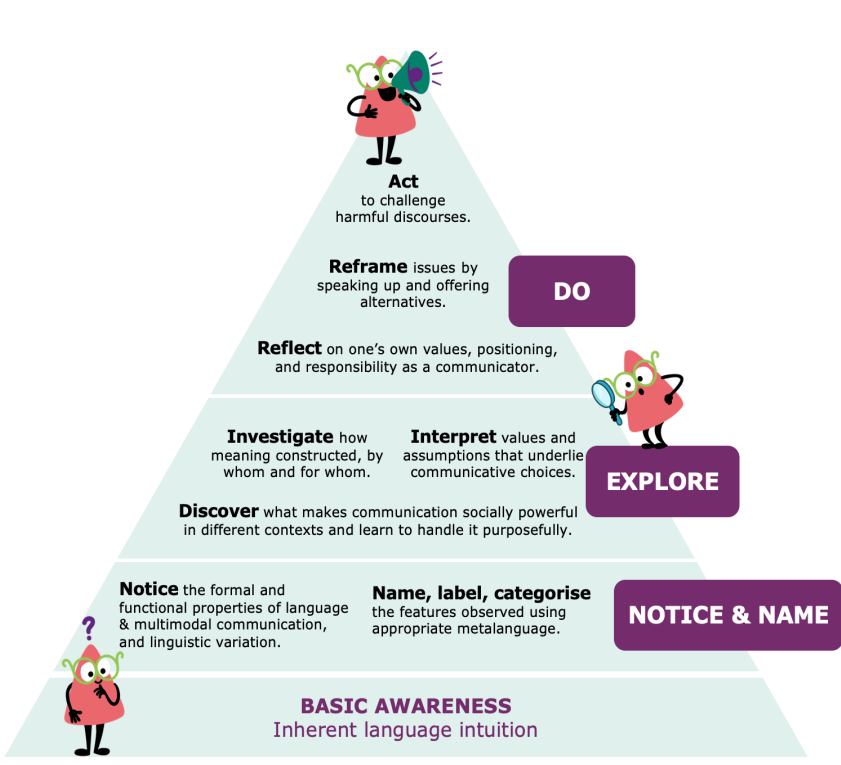
Image: Pyramid of Critical Language Awareness (CLA) Pedagogy. CLADES project.
Why is this course relevant for everyone?
“Because language is everywhere!” say Joanna Chojnicka and Erika Darics, the educators responsible for developing the course content, together with a member of the CLADES project team.
Language is around us. In a news headline. In a political speech. In a sustainability report. In the way companies apologise after a crisis. In the words used to describe migration, climate change, gender, or poverty.
The course becomes particularly relevant in an era shaped by misinformation, algorithmic communication, and polarised debates. It reminds participants that communication is never just about transmitting information. It is also about shaping perception, assigning responsibility, and influencing behaviour.
For students, educators, policymakers, communicators, journalists, practitioners, and anyone navigating digital media daily, learning to critically analyse language is no longer a niche academic skill. It is becoming a civic necessity. An individual and collective responsibility.
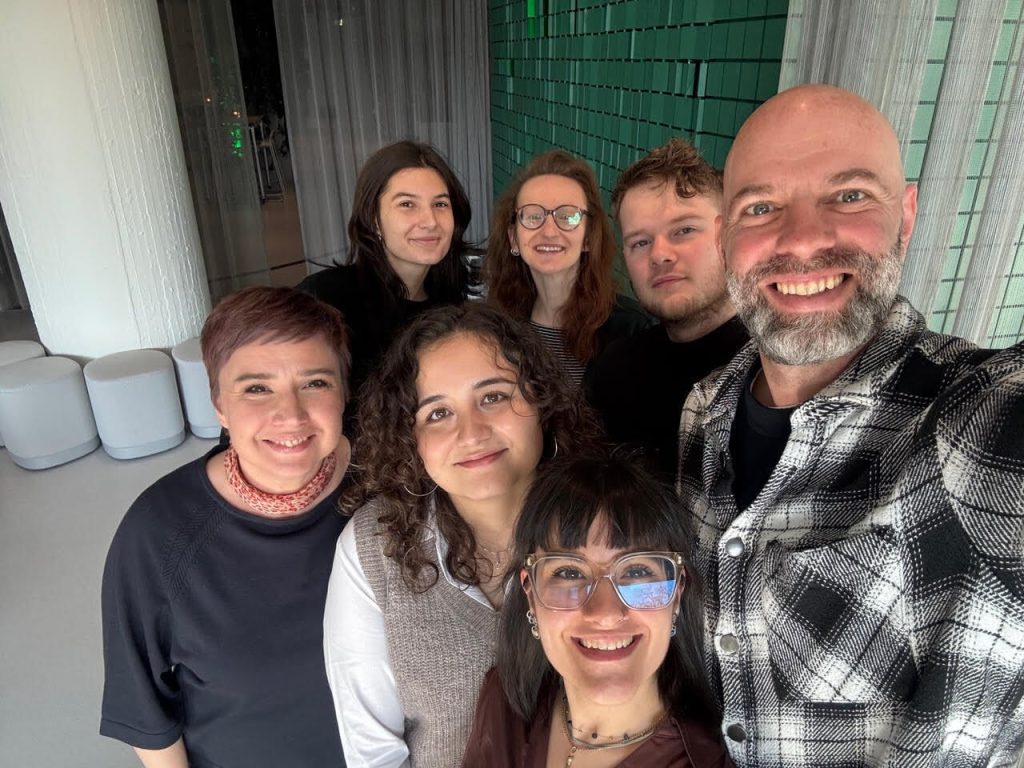
Picture from left to right: front: Erika Darics, Julie Tipsmark Matsuzawa, Letizia Prostamo, Matt Drury; back: Bianca Andrei, Joanna Chojnicka, Timo Boom.
How can you join?
The course is fully online, free to access, and requires around three hours of study per week.
Joining is simple:
- Go to FutureLearn’s website
- Create an account if you do not already have one
- Search for Critical Language Awareness in Action
- Or directly access the course here:
Critical Language Awareness in Action course page
And that is it!
Sometimes, changing the way we communicate starts by learning to notice the words we usually overlook.