

Feminist Linguistics: An academic perspective on‘Mansplaining’ as an interactional phenomenon
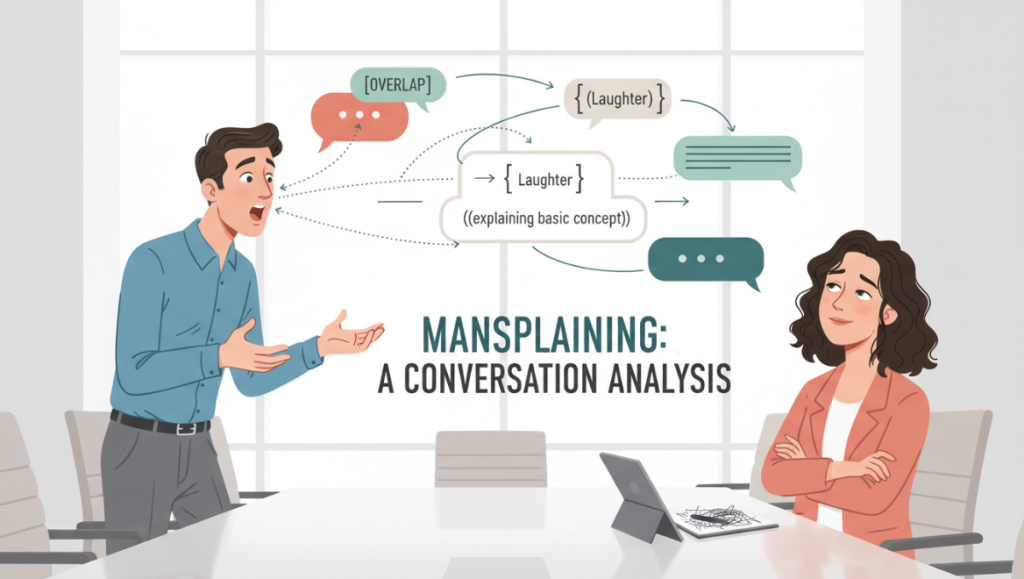
Mansplaining. A word that most non-male readers can associate with a real life experience whether in the context of work environments, university classes or simply back home at the dinner table.
Text and image by David A. Elsen.
The concept of ‘Mansplaining’ is definitely not new, first popularized by Rebecca Solnit in her 2008 essay ‘Men Explain Things to Me’. It regards instances of men explaining something unsolicitedly to a woman in a condescending tone and/or under the assumption that she is not familiar with the subject (Smith et al., 2022). While it was further popularized in the 2010’s, it is now commonly used in everyday conversations. To me, a linguist with a background in communication studies, the topic of ‘Mansplaining’ is quite interesting, as the difference between something being explained and the same thing being ‘mansplained’ can either be very nuanced or quite obvious. My mother once told me an experience of a male nurse explaining to her (an assistant doctor in a hospital right after being done with her medical degree) how to take blood from patients. While it was not necessarily condescending in tone, the underlying assumption that a person with a finished medical degree could not take blood from patients left her baffled.
Defining ‘Mansplaining’
This instance shows the problematic ambiguity that instances of ‘Mansplaining’ often demonstrate. The research of Cortina et al. (2017) shows that in the context of the workplace, acts that are rude, condescending and result in disrespect are particularly harmful as organizations can regard them as routine misconduct in the form of micro-aggressions without direct intent of the perpetrator. While these acts of disrespect and harmful treatment lack consequences for the perpetrators, the resulting harm on the victims is even greater.
Within communication studies ‘Mansplaining’ has been taken under the investigative lens as a social phenomenon. Smith et al. (2022) focused on the definition of ‘Mansplaining’ to contrast it more clearly from just unicivil and rude behavior. They expand the traditional themes that ‘Mansplaining’ carries such as “(1) unsolicited and unwelcome advice; (2) explanations of a topic or issue one knows well; and (3) condescending and patronizing tones” (Smith et al., 2022, p. 1792) with three additional themes that are associated with the experience of being ‘mansplained’ to. These additional themes concern (1) the attitude of the perpetrator towards the victim, questioning their knowledge or expertise, (2) communicating in an arrogant manner and (3) the phenomenon of the perpetrator being wrong about the information they ‘mansplain’. Their study also indicates that the understanding of ‘Mansplaining’ needs to be sensitive to the gender diversity of the victims. While the perpetrator’s gender is almost always male the victim’s gender should more clearly be regarded as most typically non-male. The research done helps with the clear defining and building of sensitivity around the concept ‘Mansplaining’.
A Qualitative Investigation
To help increase the understanding of ‘Mansplaining’ (and to put some newly acquired research skills to use) I performed a little pilot study on ‘Mansplaining’. Rabelo Duarte Vaz et al. (2023) investigate the experience of women in their professional careers, focusing on the cultural and social barriers that they encounter. They point out that more research needs to be done based on the experience of victims of sexist processes as data. This pilot study aims to address this by using a qualitative interview of a female participant’s experience as data. Using a methodological approach from Professor Elizabeth Stokoe I combined Conversation Analysis and Feminist analysis to analyze the properties and behaviors associated with the perpetrator and victim of an instance of ‘Mansplaining’ within the format of a narrative interview.
I performed the interview with a participant I recruited through convenience sampling. As Stokoe and Edwards (2007) discuss, the goal of a narrative interview is to get the most uninterrupted account from a participant regarding a topic while minimizing researcher bias (i.e. any effect that the presence of a researcher has on the participant). This approach that I used also involves minimal responses to the participant as they tell their narrative with only simple backchannel answers such as “Oh yeah?” or repeating the last sentence the participant uttered before a pause in the form of a question to help the participant continue their narrative without being guided by the researcher.
Narratives in conversation function as “the primordial organizing and sense-making framework of social life” (Stokoe & Edwards, 2007, p. 56). A recalled story indicates how one constructs their social reality and how social identities are interpreted. Stokoe and Edwards use narrative interviews to analyze how social identities are constructed by the interviewees and what properties are associated directly with certain social identities. In the context of ‘Mansplaining’ this method is useful to see what exact properties are connected to the perpetrators and how the victim experiences being ‘mansplained’ to. This insight helps identify instances of ‘Mansplaining’ more quickly and aids the development of methods for sensitivity training for companies and other organizations.
The analysis is based on a research approach spearheaded by Elizabeth Stokoe in her 2009 article “Doing actions with identity categories: Complaints and denials in neighbor disputes.” (Stokoe, 2009) in which she uses ‘Membership Categorization Analysis’ as a methodological tool to analyze how social identities are established in spoken interaction. In the article she analyzes how speakers in interaction organize their own and other’s membership of different social identities. This process is normal in human interaction and aids understanding between people in interaction. A problem arises though when negative properties are categorically associated with certain social identities which then are automatically projected onto a person as soon as they are categorized within that social identity. This form of social categorization and projection of associated properties can lead to discriminatory practices such as ‘Mansplaining’.
In the interview the participant retold her experience of handing over the projects she worked on at the end of an internship to the man she substituted for over the summer. In this process of handing over the projects the participant had handled and improved, the worker she substituted for was clearly ‘Mansplaining’ as seen in the following excerpts.
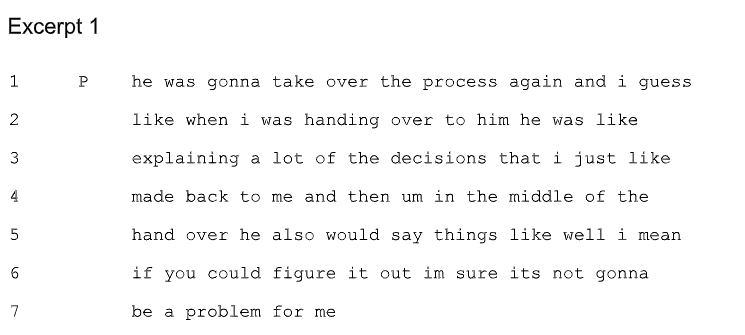
In this instance the substituted man clearly displays ‘Mansplaining’ behavior as his attitude is questioning the participant’s expertise and identifying himself with better expertise and skills than the participant’s. In this effort he firstly explains all of the decisions made by the participant who consciously made the decisions in the first place while working on the projects. In this he assumes that they were not made consciously and need to be explained again. This is then followed by a clear relativizing of any effort made by the participant while she was working by equating his own skills and expertise as superior. This arrogant attitude is exactly what Smith et al. (2022) analyzed to be inherent to ‘Mansplaining’. In the next excerpt the participant’s own experience is retold as well.
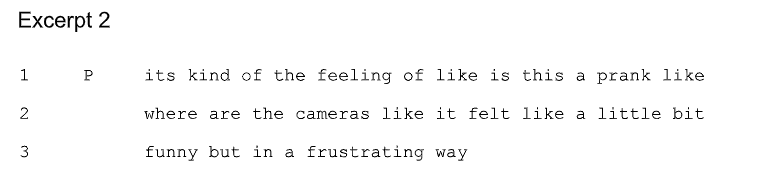
In excerpt 2 the participant explains how she felt while being ‘mansplained’ to. Interestingly, in her retelling of her experience the frustration she experiences is the final remark. The substantive part of her utterance focuses on her being baffled by the man’s behavior and utterances. This experienced disrespect resonates with the themes associated with ‘Mansplaining’ identified by Smith et al. (2022). It reflects the absurdity experienced by the participant which explains her hesitancy on what to do about it. Answering a tagged question of the interviewer on why she did not respond to it directly the participant’s perspective is visible in excerpt 3.
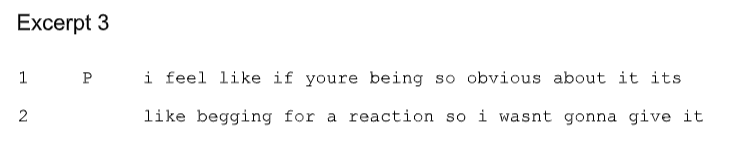
In this excerpt the participant presents an interesting perspective on the perpetrator. She sees the act of ‘Mansplaining’ as almost a request for action, trying to push the victim far enough to elicit a response to the disrespect.
The retold experience of the participant shows the different aspects of ‘Mansplaining’ as an interactional phenomenon. Analyzing the victim’s experience of the instance provides useful information on how ‘Mansplaining’ appears in interactions, how it is perceived and lays ground for further investigation on the power dynamics at play and underlying intentions of the perpetrators need to be addressed in future research. This is central in the pursuit of creating more inclusive environments and sensitizing society further on sexist interactional phenomena such as ‘Mansplaining’.
References
Cortina, L. M., Kabat-Farr, D., Magley, V. J., & Nelson, K. (2017). Researching rudeness: The past, present, and future of the science of incivility. Journal of Occupational Health Psychology, 22(3), 299–313. https://doi.org/10.1037/ocp0000089
Rabelo Duarte Vaz, E., Gallon, S., & Mendonça Fraga, A. (2023). “we go through a bit of everything”: The Labyrinth career of the professional trajectories of executive women. Review of Business Management, 25(1), 88–107. https://doi.org/10.7819/rbgn.v25i1.4213
Smith, C. J., Schweitzer, L., Lauch, K., & Bird, A. (2022). ‘well, actually’: Investigating mansplaining in the modern workplace. Journal of Management & Organization, 30(6), 1790–1808. https://doi.org/10.1017/jmo.2022.81
Stokoe, E., & Edwards, D. (2007). Story formulations in talk-in-interaction. Benjamins Current Topics, 69–79. https://doi.org/10.1075/bct.6.08sto
Stokoe, E. (2009). Doing actions with identity categories: Complaints and denials in neighbor disputes. Text & Talk – An Interdisciplinary Journal of Language, Discourse Communication Studies, 29(1), 75–97. https://doi.org/10.1515/text.2009.004